

How Many Chapters Are There
If y'all're embarking on the journey of writing a novel, you probably have several questions about where and how to start.
Planning and outlining your story in advance can be extremely helpful, but a large question that a lot of new authors accept is "How many chapters should I take in my volume?"


Free TOOL
Book Outline Template Generator
Cull your Fiction or Nonfiction volume blazon below to get your free affiliate by affiliate outline!
Enter your details below and get your pre-formatted outline in your inbox and start writing today!
CONGRATULATIONS
Thanks for submitting! Check your email for your volume outline template.
In the meantime, bank check out our Book Outline Challenge.
How many capacity should be in a novel?
The short answer is, unfortunately, that at that place is no one correct respond to that question. The boilerplate number of chapters in a novel, non accounting for genres or target audience is near a dozen.
However, there is no exact minimum or standard for how many chapters a novel should accept. Because chapters are simply places where the author decides to break upward the menstruation of their story, y'all could go a more traditional route and stop up with 12-28 chapters or cull to exist more experimental and have as many as 200.
Looking at some popular novels, even with like themes and audiences, there is a great variation in overall length and number of chapters.
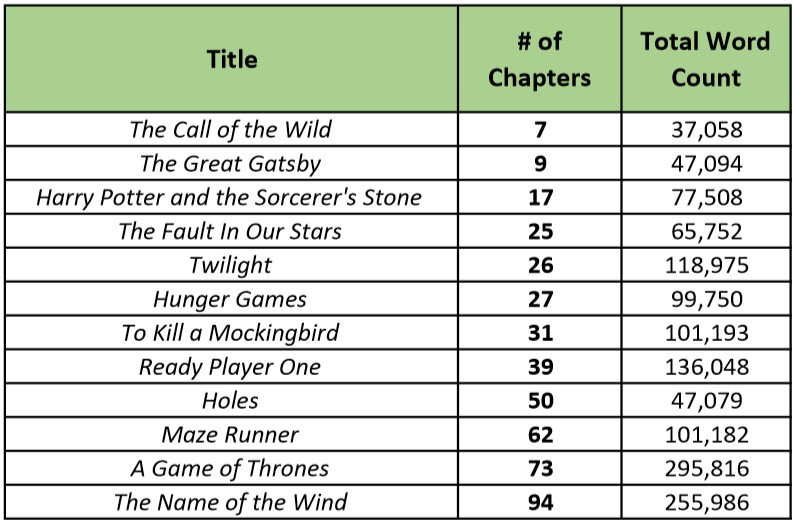
The first installment in the Harry Potter series totaled 17 capacity with most 77,500 words total whereas The Hunger Games topped out at 27 chapters with a word count of 99,750.
Your story is unique, and the number and length of the chapters inside it will reflect that.
Here are the things you should keep in listen while trying to determine how many chapters YOUR novel should have:
Why Practice Nosotros Use Chapters?
In trying to determine the number of chapters your novel will take you must kickoff understand WHY yous might want to include capacity at all. They aren't mandatory by any means, just they tin be a very useful tool in structuring the overall story in a way that is more easily digestible to the reader.
The terminate of each chapter gives the reader a solid place to take a moment and process everything they've only read. Since it'southward non always feasible to read an entire novel in one sitting, they as well allow for a practical place for the reader to take a longer interruption and practice other things. Merely they shouldn't be so satisfied that they don't desire to come up back and read the adjacent affiliate.
With that in mind, information technology makes sense to suspension up your book into sections that leave the reader both with some level of fulfillment but with an eagerness to know more. No one chapter should wrap up the story entirely except the very last i. At the same time, you don't want to keep raising questions that never get answered or issues that never become resolved. That's a surefire way to disappoint or lose the attention of your reader.
Which Books Need Chapters?
Longer novels are likely to have more than chapters simply because at that place will exist more opportunities for breaks throughout the story. Just what if yous're writing a shorter story? Shorter fiction can be a great fashion to experiment with flow and pacing and can help familiarize you with the process of writing and dividing a piece into chapters.
Brusque stories, which are usually between one,000 and 7,500 words long and very rarely have chapters. They do, withal, sometimes include scene transitions and breaks to denote a modify in setting or scene, or the passage of fourth dimension.
Novellas are longer than brusque stories, but still only clock in at around 20k words at their longest. With these, the line gets a little blurrier. Yous could choose to forego official chapters in favor of breaks equally you would for a short story or break it into defined chapters. This decision will largely depend on the overall length of the novella and the number and lengths of scenes.
Even if you're writing not-fiction, or some other type of book, chapters tin be a handy tool in your writer'due south toolbelt. For case, a cookbook could fifty-fifty be divided into chapters that focus on a certain type of dish like dessert, or a certain type of cuisine like French.
When Should I Split My Book Into Capacity?
Now you know why you need chapters, but when is a good time to divide your volume into chapters? Should you determine during the outlining stage? Should you lot look until the second draft?
There's no "one size fits all" approach to writing a book. Ane person may strongly suggest confronting writing without planning your chapters starting time, while others will tell y'all it's illogical to even CONSIDER chapters at all until you lot have a solid first typhoon.
What works for yous will depend largely on your personal writing style, but these are some methods to consider:
#one – Write Offset, Ask Questions Later
One way to chop your volume into chapters is to just write the whole thing as a draft then go dorsum through later and divide it into capacity where it makes the about sense. This will work amend for those who consider themselves to be "pantsers", or those who tend to write exploratory or "nothing" drafts rather than abide past a specific outline.
With this method, you would write an entire first draft without worrying about specific chapter pause placement. You can and so read it back, making annotation of where breaks would make sense. This could be after major scenes Look for places where some questions have been resolved, but there is plenty tension to keep the reader craving more. You lot don't necessarily need to end each chapter with a classic cliffhanger, merely you tin utilize chapter breaks to highlight building tension and continue the reader on their toes.
Another mode to determine where your affiliate breaks should go is by looking for natural pauses in the story. Peradventure you've reached the terminate of a major issue or plot bespeak. Perhaps your protagonist has simply learned something that will change the course of their storyline. Anywhere that it would make sense for the reader to ruminate about what they just read is a bully place for a affiliate break.
#2 – Build Capacity Into Your Outline
If you are a staunch outliner and organizational savant, you might consider breaking your story into chapters before yous fifty-fifty begin the first typhoon. This method volition probably work best for people who like to have very specific and thorough outlines.
Using this method, you lot can plan which scenes you want to include in each chapter and have them work intentionally with the overall structure of your story. This should also make the process of writing and editing your first draft easier. You can e'er rework them if you detect out that information technology's not working properly as planned, but information technology will give you a great jumping off bespeak.
#three – By the Numbers
If you lot don't want to exercise a thorough outline, only desire a good way to gauge how many chapters yous should end up with, you lot tin can use an average number for whichever genre and category yous are writing as a good base and go from there.
For instance, an average YA novel is betwixt 55,000 and 80,000 words long. About experts agree that 3,000-5,000 words per affiliate is a good guideline to follow. So, 12-27 chapters for a YA novel would be a good range to starting time with.
From there, you can narrow it down a little more by checking out like books within the specific genre you're writing. Contemporary stories in the YA category tend to be shorter, whereas fantasy and sci-fi are unremarkably longer and more complex.
Shawn Coyne from Story Grid does a groovy chore at explaining the math of a novel here, including a breakdown of cardinal scenes, word counts, and deed construction.
What Makes A Skillful Chapter?
The most of import affair to consider when determining how many capacity your book will have is the content, pacing, and menstruum of your story. You want to ensure that each chapter starts in a identify that engages the reader, keeps their interest throughout, and ends in a way that leaves them wanting to know more.
More often than not, you should try to resolve at least one matter past the end of each chapter, in lodge to give the reader some sense of satisfaction only leave the door open for them to continue reading.
How Long Should Each Chapter Be?
Chapters usually range from about ane,500 to 5,000 words. The length of each chapter will vary throughout your novel depending on how it'due south paced and how much information is in each department. What genre y'all are writing and who you're writing for could play a role equally well. Some genres exit more room for experimentation when it comes to chapter length, but it's of import to keep your reader in heed. One affiliate from Stephen Rex's 1987 novel Misery was comprised of a unmarried word— "Rinse".
Shorter capacity can greatly influence the pacing of a novel and help to build tension. Conversely, longer chapters may serve to slow a story and can be used to communicate more than thoroughly. Both should be used cautiously and intentionally so that readers don't feel similar they are slogging through or being rushed through with niggling to no respite.
Should My Chapters Have Titles?
Titling capacity is withal another thing that mostly comes downward to preference. Chapter titles aren't unremarkably necessary, but some authors similar to include them.
Before you make up one's mind to requite the chapters in your volume titles, consider the following:
#1 – Will Chapter Titles Do good the Story?
Chapter titles can be beneficial in multiple ways. They tin serve as precursory hints of what is coming in each affiliate. This could aid spark the reader's interest and spur them forward in the story.
They can as well be very useful in differentiating characters in stories with multiple points of view. Each chapter tin exist titled with the proper name of the character through which the story is being told.
#2 – Will Chapter Titles Benefit the Reader?
Giving your capacity titles can be practically useful for your reader too. If a reader wants or needs to refer to something that happened in an earlier chapter, it can be easier to find what they are looking for if each chapter has a unique championship that is indicative of its contents.
They tin also be used to give the reader more information or insight. In Annie Proulx's novel The Aircraft News, she uses the names and descriptions of dissimilar sailing knots similar "Dearest Knot" or "A Rolling Hitch" which adds to the maritime feel of the story.
#3 – Tin can I Just Use Numbers?
If you're not certain that titling your chapters is necessary, or you don't recall information technology would be benign to the reader or add together to your story, yous can ever merely use numbers.
Information technology's simple, classic, and a perfectly good way to characterization your chapter breaks without distracting from the story itself.
So How Many Chapters Should I Aim For?
Every bit previously stated, at that place's no magic number. The all-time way to know how many chapters y'all should write is to write an outline or draft and see what feels most natural with your story. So make sure that information technology flows properly, and the pacing is on betoken.
Make sure that the position of the breaks adds to the story rather than detracting from it. When y'all have done all of that, you should end up with a perfectly appropriate number of capacity for your novel.
However, y'all may desire to set a affiliate goal equally a way to visualize your book'due south construction and motivate yourself. In that case, I recommend you shoot for 15 chapters in a first draft. If yous write fifteen chapters at an average of 4,000 words per affiliate, y'all'll accept a solid threescore,000-word manuscript. From there you lot tin can add to or edit down to get your desired length.
FREE TOOL
Book Outline Template Generator
Choose your Fiction or Nonfiction book type below to become your free chapter past affiliate outline!
Enter your details below and get your pre-formatted outline in your inbox and commencement writing today!
CONGRATULATIONS
Thank you for submitting! Check your e-mail for your book outline template.
In the meantime, check out our Book Outline Challenge.
What is the shortest chapter y'all've read that had a big touch on the story in some way? Tell us in the comments below how it afflicted the overall story.
Disclosure: Some of the links above may incorporate affiliate partnerships, pregnant, at no additional cost to you, Self-Publishing Schoolhouse may earn a commission if you click through to make a purchase.

How Many Chapters Are There,
Source: https://self-publishingschool.com/how-many-chapters-in-a-novel/
Posted by: colemanonstonly.blogspot.com
0 Response to "How Many Chapters Are There"
Post a Comment